10 Software Development Trends Every CTO Should Know in 2026
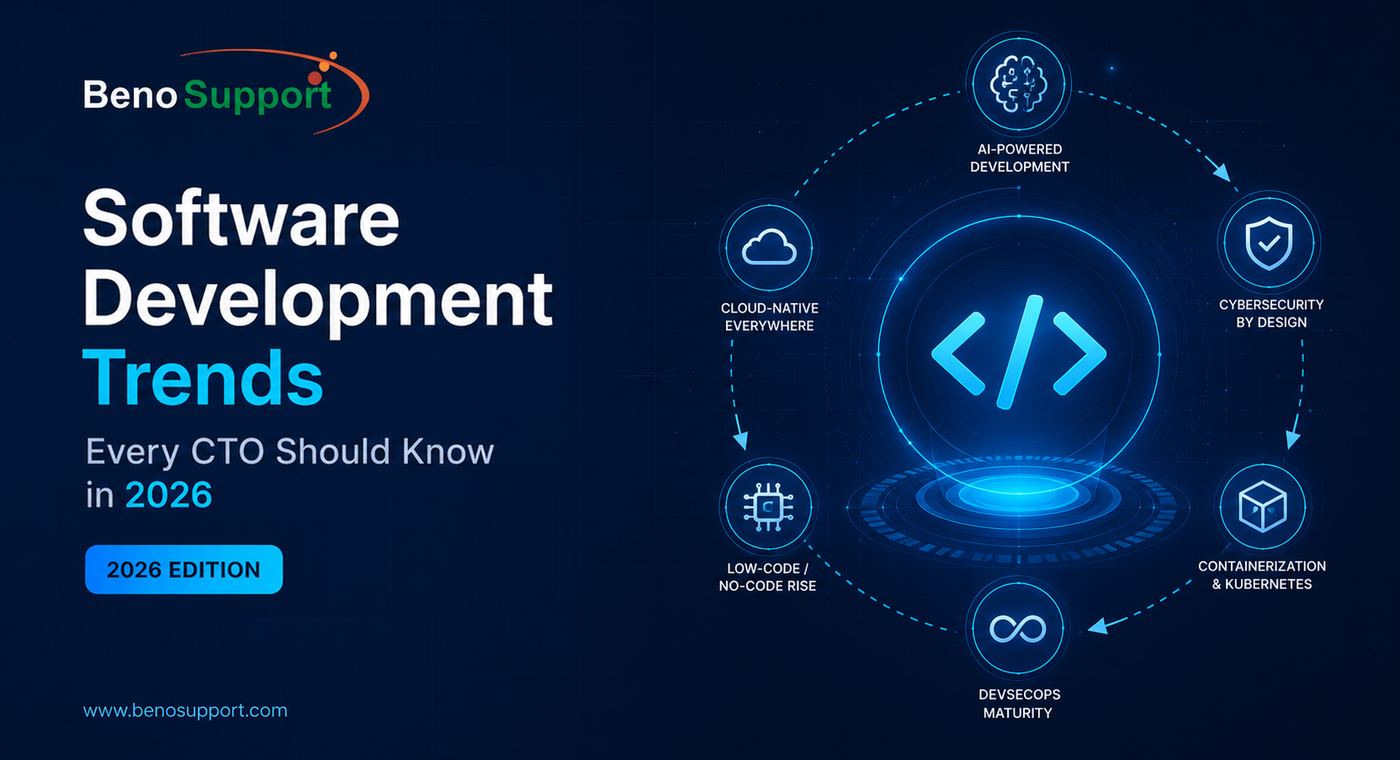
Technology is evolving faster than ever, and software development is no longer just about writing code. In 2026, CTOs are expected to make strategic technology decisions that improve operational efficiency, strengthen security, reduce costs, and prepare businesses for long-term growth.
The pace of change is being accelerated by AI, cloud-native architecture, platform engineering, and rising security expectations. For example, GitHub reported that developers using Copilot completed certain coding tasks up to 55% faster in a controlled study, while McKinsey estimates generative AI could add $2.6 trillion to $4.4 trillion annually to the global economy. At the same time, IBM’s 2024 Cost of a Data Breach Report placed the average breach cost at $4.88 million, showing why software strategy and risk management now go hand in hand.
From AI-powered development to cloud-native architecture, organizations that embrace modern software engineering practices are delivering products faster while staying resilient in an increasingly competitive market.
In this guide, we'll explore the most important software development trends shaping 2026 and explain how technology leaders can prepare their organizations for the future.
Why CTOs Must Stay Ahead of Software Development Trends
Modern businesses depend on software for nearly every business function—from customer experience and operations to analytics and automation.
Keeping pace with software development trends helps organizations:
- Accelerate product delivery
- Reduce technical debt
- Improve application performance
- Strengthen cybersecurity
- Scale infrastructure efficiently
- Increase developer productivity
- Deliver better customer experiences
The companies leading digital transformation are investing not only in new technologies but also in scalable engineering foundations. In many organizations, the difference between market leaders and laggards is no longer access to software—it is the speed, quality, and resilience of software delivery.
Top 10 Software Development Trends Shaping 2026
Software development is evolving rapidly, driven by AI, cloud-native technologies, platform engineering, cybersecurity, and automation. While every organization has unique priorities, several technology trends are emerging as clear strategic investments for CTOs in 2026.
Here are the ten software development trends that are reshaping how businesses build, deploy, and scale modern applications.
1. AI Is Becoming a Core Part of Software Engineering
Artificial Intelligence has moved beyond experimentation.
In 2026, AI assists developers throughout the software lifecycle, including:
- Code generation
- Automated testing
- Bug detection
- Documentation
- Refactoring legacy code
- Performance optimization
Rather than replacing software engineers, AI helps development teams spend more time solving business problems and less time on repetitive coding tasks. This shift is already measurable: GitHub’s controlled study found that developers using Copilot completed tasks up to 55% faster, and McKinsey estimates generative AI could create $2.6 trillion to $4.4 trillion in annual economic value.
What CTOs should do
- Adopt AI-assisted development responsibly
- Establish governance for AI-generated code
- Review security and compliance before production deployment
- Train engineering teams to collaborate effectively with AI tools
Practical CTO takeaway
AI should be treated as a productivity layer, not a shortcut. The best results come when AI is paired with strong engineering standards, code review discipline, and clear ownership.
2. Platform Engineering Is Replacing Traditional DevOps
Many engineering organizations are shifting toward platform engineering.
Instead of every development team managing infrastructure independently, platform teams create reusable internal developer platforms that standardize deployments, security, monitoring, and CI/CD.
Benefits include:
- Faster software releases
- Better developer experience
- Reduced operational overhead
- Consistent security practices
- Easier scaling
Organizations with mature platform engineering practices often achieve greater development velocity while maintaining operational reliability. This matters because engineering teams lose significant time when they must repeatedly solve the same infrastructure, deployment, and observability problems.
What CTOs should do
- Build internal platforms that reduce friction for developers
- Standardize deployment pipelines and observability
- Create reusable templates for services, environments, and security controls
- Measure developer experience as a business metric
Practical CTO takeaway
Platform engineering is not just an infrastructure initiative. It is a force multiplier for product delivery, security, and engineering consistency.
3. Cloud-Native Development Continues to Dominate
Cloud-native applications have become the preferred architecture for modern businesses.
Key technologies include:
- Containers
- Kubernetes
- Microservices
- Serverless computing
- Event-driven architecture
Cloud-native development enables organizations to scale applications on demand while improving resilience and reducing infrastructure complexity. It also supports faster release cycles, better fault isolation, and more flexible deployment strategies.
CTOs should prioritize architectures that allow applications to evolve without large-scale rewrites. In practice, this means designing systems that can be updated incrementally rather than replaced all at once.
What CTOs should do
- Assess which workloads should move to cloud-native patterns
- Avoid unnecessary complexity in early-stage products
- Use containers and orchestration where scale and portability matter
- Design for resilience, observability, and cost control
Practical CTO takeaway
Cloud-native is not about using every modern tool. It is about choosing the right architecture for scale, reliability, and long-term adaptability.
4. Cybersecurity Is Built Into Development
Security is no longer a final testing phase.
Modern engineering teams embrace DevSecOps, integrating security throughout the software development lifecycle.
Common practices include:
- Automated vulnerability scanning
- Infrastructure security checks
- Secure code reviews
- Dependency monitoring
- Continuous compliance validation
Building security into development significantly reduces business risk and improves software quality. This is especially important when the average cost of a data breach has reached $4.88 million, according to IBM’s 2024 report.
What CTOs should do
- Make security part of every sprint and release cycle
- Automate security checks in CI/CD pipelines
- Monitor third-party dependencies continuously
- Train developers on secure coding practices
- Align engineering and security teams around shared metrics
Practical CTO takeaway
The most secure organizations are not the ones that test security at the end—they are the ones that design for security from the beginning.
5. Low-Code and AI-Assisted Development Are Accelerating Delivery
Businesses increasingly use low-code platforms for internal applications while professional developers focus on complex systems.
Combined with AI-assisted development, organizations can:
- Launch internal tools faster
- Reduce development bottlenecks
- Improve productivity
- Enable rapid prototyping
This trend is especially valuable for operations teams, customer support workflows, reporting dashboards, and internal automation. However, governance remains essential to maintain scalability, security, and maintainability.
What CTOs should do
- Define where low-code is appropriate and where it is not
- Establish guardrails for data access and integrations
- Ensure low-code tools fit into enterprise security standards
- Use AI-assisted development to speed up prototyping and internal tooling
Practical CTO takeaway
Low-code and AI can dramatically improve speed, but only when they are managed with the same discipline as traditional software development.
6. API-First Development Is Becoming Standard
Modern applications rarely operate independently.
API-first design allows software to integrate seamlessly with:
- CRMs
- ERPs
- Payment gateways
- AI services
- Analytics platforms
- Third-party SaaS products
Organizations adopting API-first strategies gain greater flexibility and can deliver new digital experiences faster. They also make it easier to connect internal systems, support partner ecosystems, and reuse services across multiple products.
What CTOs should do
- Design APIs before building front-end experiences
- Standardize authentication, versioning, and documentation
- Treat APIs as products with clear ownership
- Monitor API performance, reliability, and usage
Practical CTO takeaway
API-first development creates a more modular business architecture, which makes innovation faster and integration less painful.
7. Modernization of Legacy Systems Remains a Top Priority
Many enterprises still rely on legacy software that limits innovation.
Instead of complete system replacement, organizations increasingly modernize applications incrementally through:
- Microservices adoption
- Cloud migration
- Application refactoring
- API integration
- Containerization
This approach minimizes disruption while improving scalability and reducing maintenance costs. It also helps organizations avoid the risk and expense of large-scale “big bang” migrations.
What CTOs should do
- Identify legacy systems that block growth or create risk
- Prioritize modernization based on business impact
- Use phased migration strategies instead of full replacement where possible
- Preserve critical business logic while improving architecture
Practical CTO takeaway
Legacy modernization is not just a technical cleanup exercise. It is a strategic investment in agility, resilience, and future growth.
8. Data-Driven Engineering Decisions
Engineering leaders now rely heavily on real-time metrics.
Important software engineering KPIs include:
- Deployment frequency
- Lead time for changes
- Mean Time to Recovery (MTTR)
- Change failure rate
- Application availability
- Infrastructure utilization
- Customer experience metrics
Observability platforms enable CTOs to make informed decisions using operational data rather than assumptions. This is especially important because high-performing teams tend to ship smaller changes more frequently and recover from incidents faster.
What CTOs should do
- Track engineering metrics that connect to business outcomes
- Use observability tools to monitor performance and reliability
- Review delivery metrics regularly with product and engineering leaders
- Tie technical KPIs to customer satisfaction and revenue impact
Practical CTO takeaway
If you cannot measure delivery performance, reliability, and user impact, you cannot improve them consistently.
9. Sustainable Software Engineering Gains Importance
Efficiency is becoming a competitive advantage.
Organizations are optimizing software to reduce:
- Cloud infrastructure costs
- Compute consumption
- Carbon emissions
- Storage waste
Efficient architecture not only improves sustainability but also lowers long-term operating expenses. In many FinOps programs, rightsizing, autoscaling, and workload scheduling uncover meaningful savings by eliminating idle resources and unnecessary consumption.
What CTOs should do
- Review cloud usage regularly for waste and overprovisioning
- Optimize workloads for efficiency, not just performance
- Use autoscaling and scheduling where appropriate
- Align engineering and finance teams around cloud cost visibility
Practical CTO takeaway
Sustainable engineering is not only about environmental responsibility. It is also about building leaner, more cost-effective systems.
10. Software Architecture Is Becoming More Business-Focused
The role of the CTO is shifting from technology management to business strategy.
Modern software architecture now prioritizes:
- Business agility
- Faster innovation
- Customer experience
- Security
- Scalability
- Cost optimization
Technology decisions increasingly align with measurable business outcomes rather than technical preferences alone. That means architecture choices must support revenue growth, customer retention, operational efficiency, and market responsiveness.
What CTOs should do
- Evaluate architecture decisions through a business lens
- Align engineering roadmaps with company goals
- Prioritize systems that improve speed to market
- Balance technical excellence with commercial impact
Practical CTO takeaway
The best architecture is not the most complex one—it is the one that helps the business move faster, safer, and more profitably.
Frequently Asked Questions (FAQ)
What is the biggest software development trend in 2026?
Artificial Intelligence integrated into the software development lifecycle is one of the most significant trends. AI helps improve developer productivity, automate testing, accelerate coding, and optimize software maintenance while supporting engineering teams rather than replacing them.
Why is cloud-native development important?
Cloud-native architectures improve scalability, resilience, deployment speed, and infrastructure efficiency, making them ideal for modern digital products.
Should every company adopt microservices?
Not necessarily. Microservices offer flexibility for complex, growing applications, but smaller projects may benefit from a modular monolithic architecture. The right choice depends on business requirements, team size, and long-term scalability goals.
What skills should CTOs prioritize in 2026?
Technology leaders should strengthen expertise in:
- AI-assisted software development
- Cloud architecture
- Platform engineering
- Cybersecurity
- Data engineering
- Enterprise architecture
- Engineering leadership
- Automation
Building Future-Ready Software Requires the Right Engineering Partner
Keeping up with software development trends is only the beginning. Successful organizations need scalable architecture, modern engineering practices, secure development workflows, and experienced teams capable of turning business ideas into reliable digital products.
Whether you're modernizing legacy systems, building AI-powered applications, or launching a new digital platform, a strong engineering foundation makes all the difference.
At Beno Support, we help startups, SMBs, and enterprises design, build, and scale secure, cloud-ready software solutions through our Core Engineering & Application Architecture services. From product strategy and application modernization to cloud-native development and scalable architectures, our engineering teams work alongside businesses to deliver technology that supports long-term growth.
Explore our Core Engineering & Application Architecture services to learn how we can help accelerate your next software initiative: https://www.benosupport.com/services/core-engineering-application-architecture
You can also explore our full range of digital transformation and software engineering solutions at: https://www.benosupport.com/